How Much Exercise Does a Akita Need? Plus Brain Games
General training information. Every dog is an individual; for health or behavior concerns, see your veterinarian.
If you are asking how much exercise a Akita needs, the short answer is less than many working breeds, but not nothing. The Akita Club of America (ACA) lists the exercise level as medium. The American Kennel Club (AKC) calls it moderate and says a jog or brisk walk at least once a day meets the needs of most Akitas.
The harder part is the mind. This is a breed that was built to think for itself on a mountain, and a bored Akita will find its own work. This guide gives you a daily plan, a set of brain games, and the mistakes to skip.
What the breed was built to do
The AKC says the Akita was bred to hunt in the mountains of northern Japan, going after elk, wild boar and bear. The Akita Club of America adds that the breed hunted bear and guarded property, and was even used as a palace guard.
That history explains a lot. A dog made for steady, purposeful work in rough country does not need a marathon every day. It does need a job that uses its nose, its judgment and its patience. Individual dogs vary, so treat everything below as a starting point and watch your own dog.
How much exercise does a Akita need?
Neither the AKC nor the ACA gives an exact number of minutes, so we will not invent one. Here is what they do say:
- The ACA, in its Living With An Akita page, describes a good walk or jog and says this is not an overly hyper breed.
- The AKC says moderate exercise is enough, and that a jog or brisk walk at least once a day meets the needs of most.
- The ACA states plainly that an Akita should never be off leash in an unsecured area.
So the baseline is at least one purposeful outing a day, on a leash or inside a secure fence. Think of that as the floor, then add mental work on top.
Exercise by life stage
Puppies
The sources we rely on do not give puppy exercise limits or joint-protection rules for the Akita. Do not guess here. Ask your veterinarian and your breeder how much running, jumping and stair work is right for your puppy's age and growth.
What the ACA does say is useful. A cute eight-week-old is very different from a full-grown adult, and a puppy's parents matter for adult size. The ACA lists adult males at 26 to 28 inches and females at 24 to 26 inches. The AKC gives weights of 100 to 130 pounds for males and 70 to 100 pounds for females. That is a lot of dog to build good habits into, so start early.
The ACA also describes a puppy class for 3 to 5 month olds that emphasizes socialization. Check with a local Akita club or class provider about what is offered near you.
Adults
For a healthy adult, plan on the AKC's daily jog or brisk walk as the foundation. Many owners split it into two outings so the dog gets both exercise and a second round of sniffing. Add one or two short training sessions and a food puzzle, and you have covered body and mind.
Seniors
The AKC gives a life expectancy of 10 to 14 years. Neither source gives senior exercise guidance, so let your veterinarian set the pace as your dog ages. Keep the brain games going even when walks get shorter. Scent work and puzzle feeders are easy on the body.
Materials you will need
- A sturdy, well-fitted flat collar or harness and a standard leash. Choose gear that does not cause pain.
- A securely fenced yard, or a long line used only in a safe, enclosed spot.
- Small, soft treats you can break into pea-sized pieces.
- A food puzzle or snuffle mat, or household items such as a muffin tin and tennis balls.
- Cardboard boxes, towels and a few cups for scent games.
- A short list of cues you are teaching, written where you can see it.
Step-by-step: a daily Akita routine
Step 1: Start with a structured walk
Take the walk the AKC describes: brisk, steady, and at least once a day. Keep the dog on a leash. The ACA warns that an Akita that gets loose may go hunting on its own, so a secure setup matters more than distance.
Reward the dog for walking beside you. Use treats and calm praise. Skip any harsh tools or leash corrections. The American Veterinary Society of Animal Behavior (AVSAB) supports reward-based training, and it fits a dog that tends to dig in when pushed.
Step 2: Turn part of the walk into a sniff walk
Pick a safe, quiet route. For the last ten minutes or so, let your Akita lead with its nose on a loose leash. Stop when it stops. Let it check a bush or a patch of grass.
Sniffing is real work for a dog. For a breed made to track game, it is a natural fit. Done regularly, it may leave your dog calmer and more settled afterward, though every dog is different.
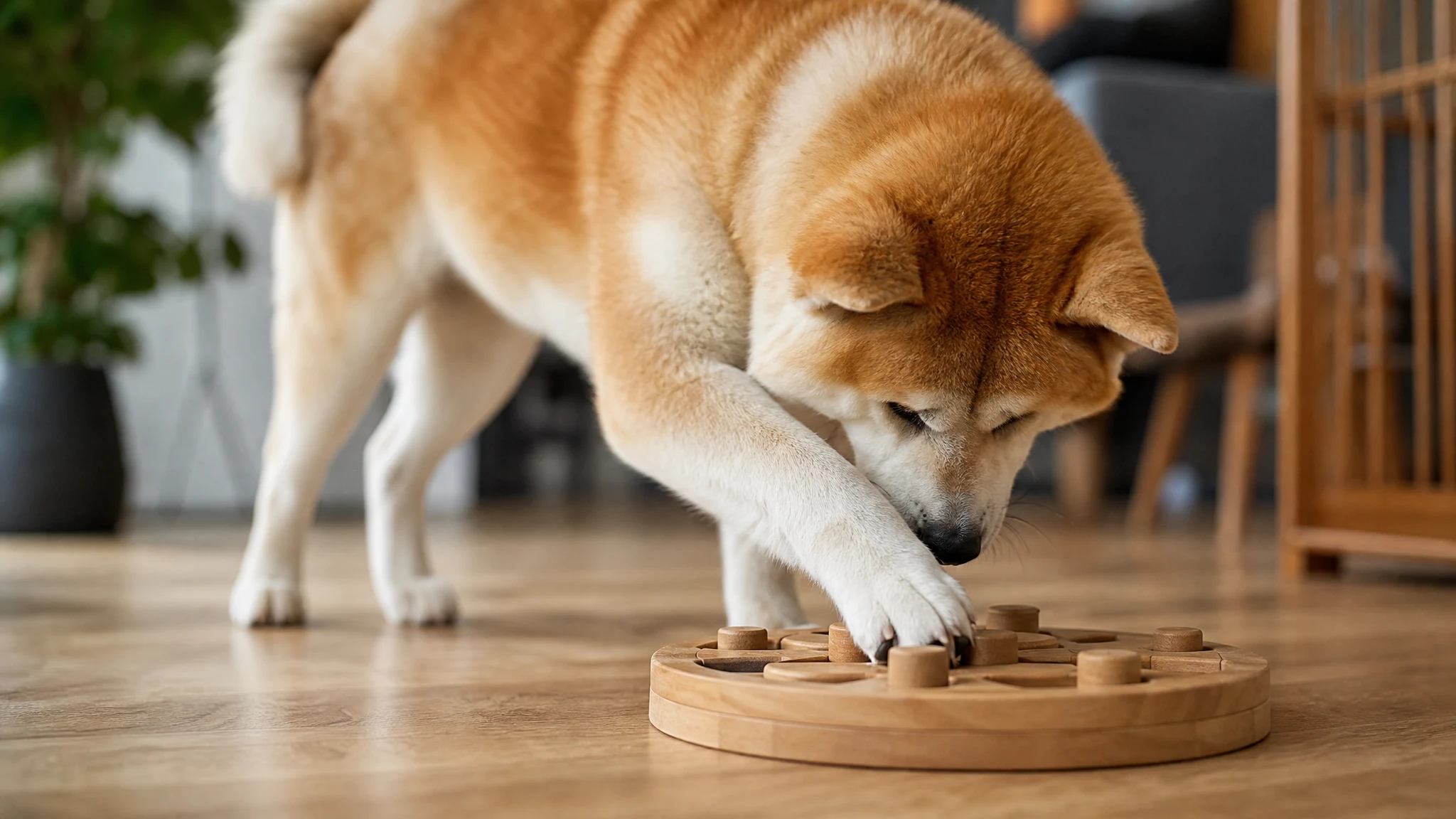
Step 3: Feed from a puzzle
Put part of a meal in a food puzzle, snuffle mat or muffin tin covered with tennis balls. Start easy so the dog wins quickly, then raise the difficulty over several days.
Ask your veterinarian about meal timing and exercise. The ACA and the AKC both list bloat (gastric dilatation volvulus) among the health concerns in the breed, and your vet is the right person to advise on feeding routines.
Step 4: Play the find-it game
This one echoes the breed's hunting past and builds focus.
- Show your dog a treat, then drop it a few feet away while saying "find it."
- Repeat until the dog runs to the spot on its own.
- Hide treats under cups or towels in the same room.
- Later, hide them in different rooms, then in boxes.
The ACA lists Scent Work among Akita activities, so this is a good first step toward a formal class if you ever want one.
Step 5: Add two short training sessions
Keep each one to five minutes or so. Work on one cue at a time, such as sit, down, wait, leave it or come. The AKC calls the Akita very intelligent and loyal but independent and headstrong, and says it must be trained consistently from puppyhood. The ACA says the breed can be very stubborn when a command is repeated.
So say the cue once. If your dog does not respond, make it easier, use a better treat or reduce distractions, then try again. End on a win. Our complete Akita training guide goes deeper on building these cues.
Step 6: Try a sport or job
The ACA's list of Akita activities includes agility, barn hunt, Canine Good Citizen and Trick Dog, dock diving, FastCAT, obedience, rally, scent work, therapy work and weight pull or carting. You do not have to compete. A beginner class in one of these can give your dog a regular job and give you a structured way to practice.
Start with the quieter options such as scent work, rally, tricks or barn hunt if your dog is wary of crowds. The AKC describes the breed as wary of strangers, so choose a calm class with enough space.
Step 7: Finish with calm time
End the day with a chew, a mat or a quiet rest in a crate or pen. The ACA notes the Akita is generally quiet, and a settled dog fits that picture. Teach the dog that downtime is also part of the routine.
A sample week
| Day | Body | Brain |
|---|---|---|
| Monday | Brisk walk | Puzzle feeder, 5-minute cue practice |
| Tuesday | Sniff walk | Find-it with cups |
| Wednesday | Brisk walk or jog | Trick practice |
| Thursday | Sniff walk | Snuffle mat meal |
| Friday | Brisk walk | Box search game |
| Saturday | Longer outing on leash | Class or sport practice |
| Sunday | Easy sniff walk | Calm chew and rest |
Tips that make it work
- Vary the route. New smells keep a walk interesting without adding distance.
- Use real food rewards. A bored, headstrong dog works better for something it values.
- Keep sessions short. Stop while your dog still wants more.
- Watch your own body language. The AKC notes that prolonged eye contact can be seen as a challenge by an Akita, so use soft glances and a calm voice.
- Plan around the weather. The breed has a dense double coat. Ask your veterinarian about exercising in heat.
Common mistakes to avoid
Using the dog park as the exercise plan
The ACA's FAQ says dog parks are not appropriate places to socialize an Akita. The ACA also says the breed has a genetic predisposition for intolerance of other dogs, especially of the same sex, and that this may not appear until the dog is fully mature. A park can turn a good young dog into a risk. Choose one-on-one meetings that you control, or solo outings.
Letting the dog off leash in an open area
The ACA says never off leash in an unsecured area. The breed has high prey drive according to the ACA's FAQ, so cats, small dogs and other small pets also need cautious introductions.
Trying to wear the dog out with more and more
Extra miles do not replace thinking work. The AKC and ACA both point to moderate exercise. If your dog is still restless after a good walk, add a puzzle or a scent game before you add distance.
Repeating cues over and over
Since the ACA describes the breed as very stubborn when a command is repeated, repeating usually makes things worse. Reset the exercise and make it easier.
Using force or intimidation
Do not use shock, prong or choke collars, alpha rolls, scruffing or other dominance methods. They are not recommended by AVSAB and can damage trust with a dog that is already wary. The ACA says the owner should lead early and train the dog personally. That means clear, consistent, reward-based teaching, not roughness.
Skipping the vet conversation
Questions about joints, bloat risk, thyroid issues or limping belong with your veterinarian. The ACA lists hip dysplasia, hypothyroidism and other conditions among the breed's more common health concerns. Do not try to diagnose your dog yourself.
What results to expect
With a steady routine, many owners find their Akita is calmer in the house and easier to focus on a walk. Sniff walks and puzzle feeders may help burn mental energy that would otherwise go into chewing, digging or patrolling the fence. Results depend on the dog's age, health, background and temperament, and nothing is guaranteed.
The ACA says the breed can be challenging for first-time owners. If your dog shows signs of aggression toward people or other dogs, contact a qualified, reward-based trainer or your veterinarian rather than trying to push through it alone.
Quick recap
- Give at least one brisk walk or jog a day, as the AKC describes.
- Keep your dog on a leash or in a secure fence at all times outside.
- Add sniff walks, puzzle feeders and scent games every day.
- Train in short, reward-based sessions with one cue at a time.
- Skip dog parks and ask your vet about puppy, senior and health questions.
Sources
- American Kennel Club, Akita breed page
- American Kennel Club, Akita History
- Akita Club of America, Living With An Akita
- Akita Club of America, Meet The Akita
- Akita Club of America, The Akita
- Akita Club of America, Frequently Asked Questions
- Akita Club of America FAQ, dog park
- Akita Club of America, How To Find the Right Puppy
- Akita Club of America, Akita Activities
- Akita Club of America, Obedience
- Akita Club of America, Health Concerns